
Stop Discriminatory Pricing and Exclusion Based on State or Independent School Labels
In partnership with:
Education-first family finance platform.
Stop Discriminatory Pricing and Exclusion Based on State or Independent School Labels
No child should be charged more or excluded from educational arts and cultural opportunities because of the school they attend.
But this happens more often than many people realise.
These policies are driven by simplistic assumptions attached to school-type labels.
Here’s the problem
School trips, workshops, outreach initiatives and educational programmes in arts and cultural institutions are meant to broaden horizons and inspire young people.
But in some cases, the price a school group is charged (and therefore what families are asked to pay) or whether children can access a programme at all, depends on the type of school they attend.
Across the UK, children are increasingly being treated differently based on assumptions linked to the type of school they attend.
This includes:
- differential pricing for educational visits and workshops
- restricted access to arts and outreach programmes
- and, in some cases, exclusion from opportunities based on school background
These decisions are often well-intentioned and linked to efforts to widen participation and improve social mobility.
However, using state and independent school labels as proxies for advantage or disadvantage is a blunt, imprecise and unreliable approach.
It risks:
- reinforcing stereotypes
- creating stigma and division
- misdirecting support
- and overlooking the real complexity of children’s circumstances
No child should be judged or categorised based on simplistic assumptions about the school they attend.
(Soon, we will turn our attention to discriminatory policies within the NHS, including cases where children who attend independent schools have been denied access to treatment and excluded from work experience opportunities).
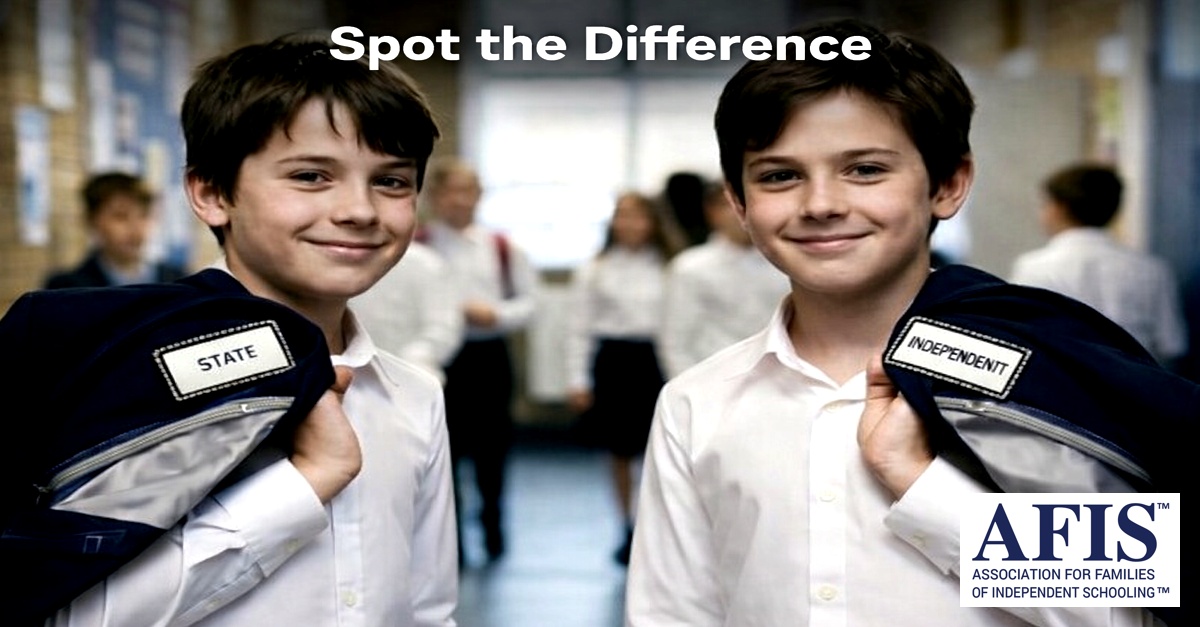
School labels are a blunt and unfair tool.
It's time we reconsidered how they are used.
School type is increasingly used as a shorthand for socio-economic background across policy, public institutions and media coverage. While often well-intentioned, this risks oversimplifying a complex reality.
Evidence and Examples
AFIS has identified numerous examples of arts and cultural organisations:
- charging independent school groups significantly higher prices for identical educational experiences
- applying differential pricing structures for workshops and activities
- restricting access to programmes based on school background
For example:
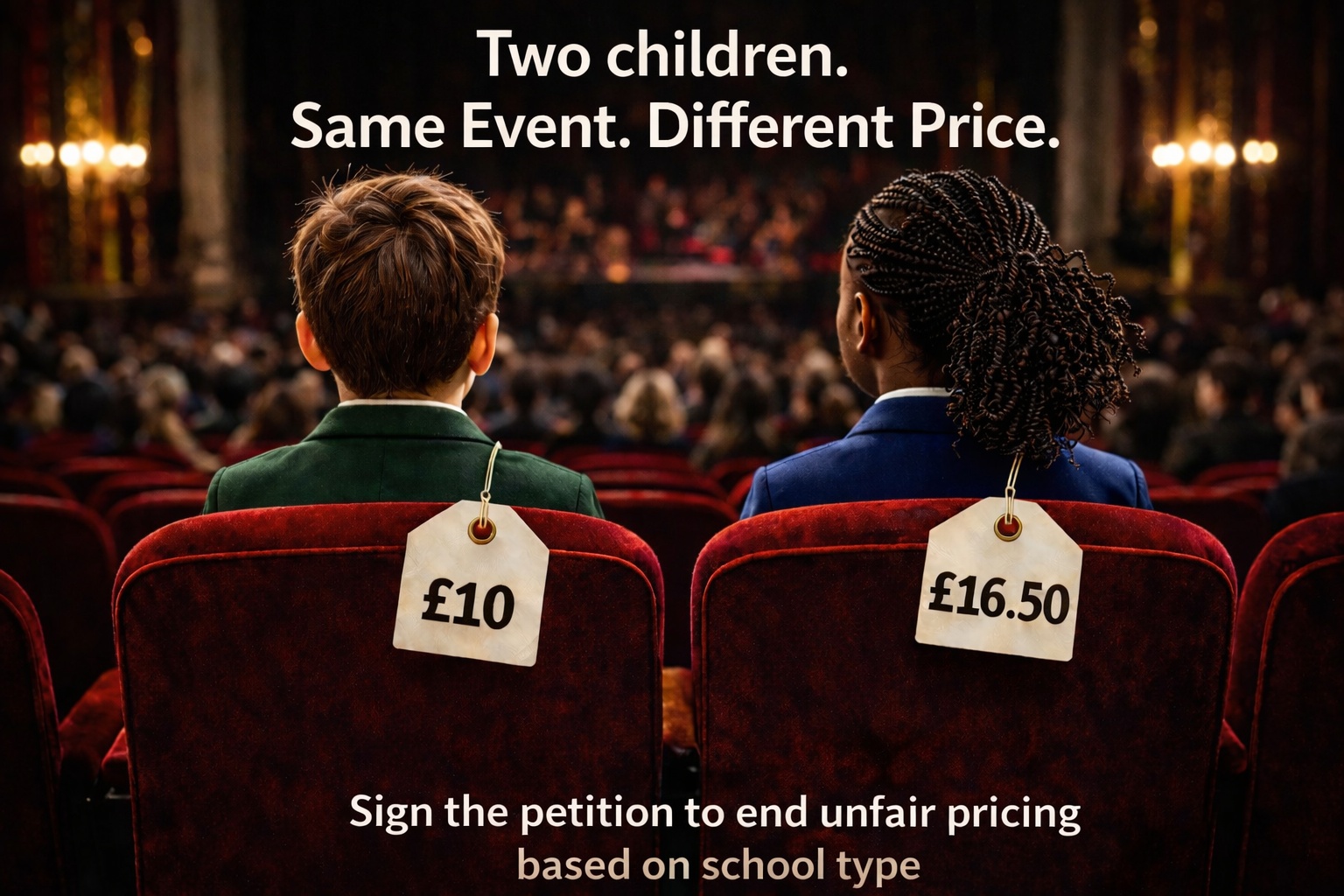
- At the Royal Shakespeare Company, school ticket pricing was published at £10 per pupil for state schools and £16.50 for independent schools
- At National Museums Scotland, workshop pricing was published at £100 for local authority schools and £150 for independent or non-local-authority schools
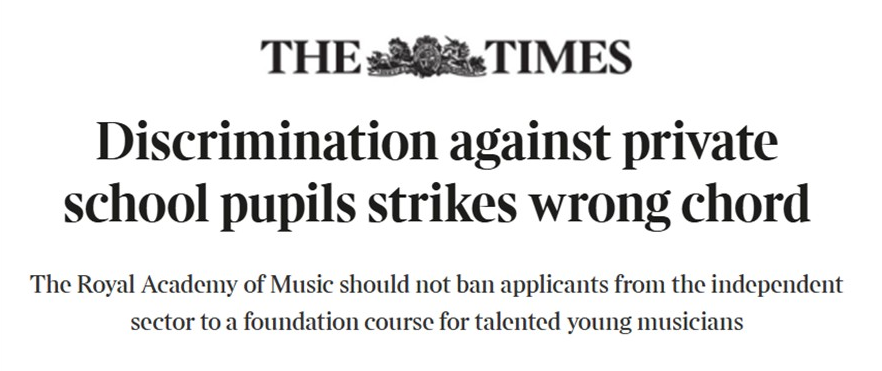
- At the Royal Academy of Music, eligibility criteria for a new foundation programme restricted applications to students from state-funded schools
These examples are not isolated; they reflect a wider and growing pattern.
Why this matters
Public debate often assumes that all independent school families are affluent and advantaged.
The reality is far more complex.
Many families make significant financial sacrifices or rely on bursaries and scholarships. At the same time, many high-income families are represented within the state sector.
AFIS analysis suggests there are around four times as many children from the highest-income households in state schools as in independent schools; in fact, there are more children from the wealthiest families attending state schools than there are pupils in the entire independent sector.
School labels do not reliably identify need.
When institutions use school background as a shortcut for socioeconomic status, support can be inaccurately targeted — excluding some children who genuinely need help while including others based on broad assumptions.
AFIS also notes that pupils attending independent schools are often excluded from eligibility measures linked to free school meal criteria, even where their education is fully bursary-funded.
The Impact
Using school labels in this way relies on simplistic, binary assumptions.
It reinforces stereotypes and creates stigma, including assumptions:
- that all children in state schools are disadvantaged
- and that all children in independent schools are wealthy and privileged
Neither reflects reality.
Children do not choose the schools they attend, yet they are increasingly being labelled and treated differently based on institutional categories rather than individual circumstances.
These approaches can also lead to inconsistent and unfair outcomes.
For example:
- a family on a lower income may be asked to pay more because their child attends an independent school
- a higher-income family may pay less because their child attends a state school
These outcomes do not reflect the real diversity of families across school types.
A better approach is possible
At AFIS, we support efforts to widen participation and improve access to opportunity.
But support should be based on real circumstances and genuine need — not crude institutional labels.
Through our Beyond School Labels: Rethinking Social Mobility campaign, we are working to promote more accurate, evidence-led and inclusive approaches to identifying disadvantage and targeting support.
AFIS is also developing practical proposals to help organisations and policymakers implement fairer and more accurate means-testing approaches based on genuine need rather than simplistic school-type assumptions.
We are engaging constructively with organisations across the arts and cultural sector, alongside government and policymakers, to explore practical and effective alternatives that promote fairness, inclusion and social cohesion.
AFIS is also examining the wider use of school-background profiling in areas including outreach, healthcare, work experience and public sector access initiatives.
What this petition calls for
We call on arts and cultural organisations to:
- review pricing and access policies linked to school background
- end the use of school labels as a basis for differential treatment
- adopt more accurate, needs-based approaches to widening participation and targeting support
- work collaboratively to ensure access policies promote fairness, inclusion and social cohesion
Because access to arts, culture and education should expand opportunity, not divide children.
Sign the petition
If you believe children should be treated as individuals, not stereotypes, please add your voice.
Sign the petition ->Please also share this campaign and help raise awareness of this growing issue.
What we will do with this petition
AFIS will share the findings of this campaign, including petition signatures and supporting evidence, with arts and cultural organisations, Arts Council England and relevant government departments.
As part of our wider campaign, Rethinking Social Mobility: Beyond School Labels, we will also continue developing constructive, evidence-based proposals to improve how support and widening participation initiatives are targeted.
Our aim is not simply to highlight problems, but to work collaboratively towards fairer, more accurate and more inclusive approaches to access and opportunity for all children.
Join us in calling for fair, accurate and evidence-based approaches to access and opportunity for all children.
Your support is essential in driving positive change.

AFIS is a non-profit organisation dedicated to championing parental choice, securing fairer representation for independent-schooling families, supporting members with benefits and resources, and widening access to independent education.
AFIS and Association for Families of Independent Schooling are registered trademarks of AFIS UK LTD.
The Association for Families of Independent Schooling (AFIS) C.I.C. is a community interest company, incorporated in England and Wales, company number 16817786.