Click HERE to Engage with AFIS on Linkedin
The latest media coverage about independent schools’ fee support mechanisms raises some legitimate questions, but also leaves out some important context.
The Association For Families Of Independent Schooling (AFIS) C.I.C. supports greater transparency around:
• means-tested bursaries
• access for lower-income families
• how fee assistance is categorised and reported.
However, the headlines are more dramatic than the underlying data.
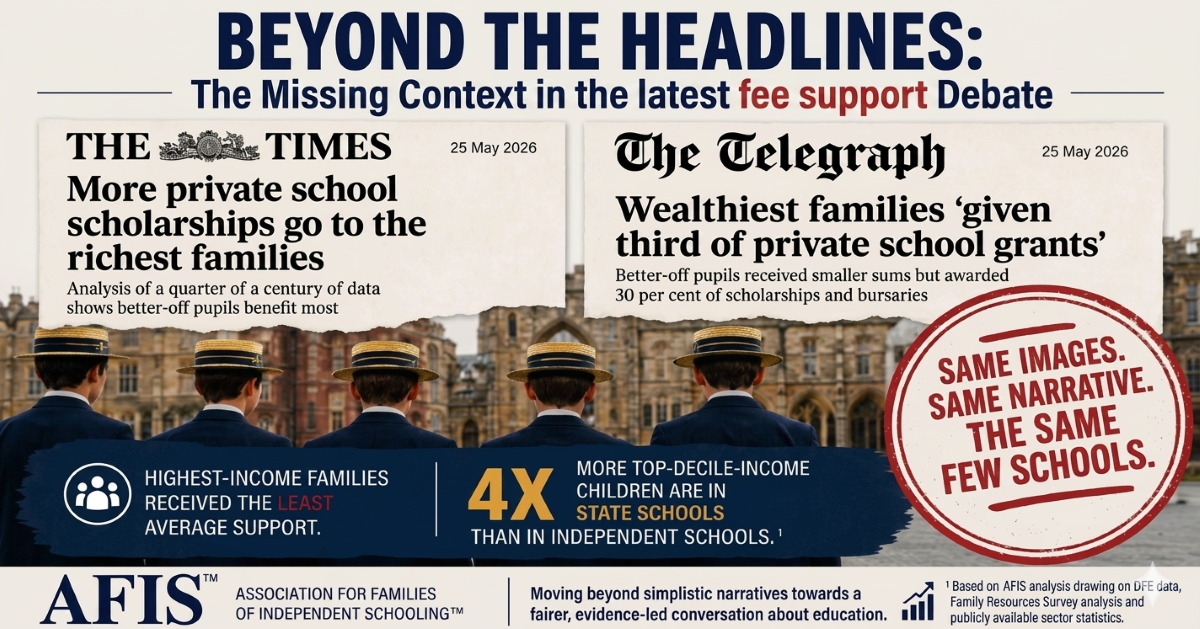
For example, The Telegraph headline states:
“Wealthiest families ‘given third of private school grants’”
Yet the article acknowledges:
• pupils from the highest-income households received the smallest average grants
• middle-income families received the largest average support
• lower-income families received more support per pupil than the wealthiest households.
That is a far more nuanced picture than many readers may initially assume.
The articles also repeatedly conflate scholarships, bursaries and fee assistance, despite these being fundamentally different mechanisms.
AFIS also questions why national newspapers continue to rely on the same stock images of Eton and Harrow to visually represent 2,500 extraordinarily diverse independent schools and around 600,000 children from a wide range of backgrounds and circumstances.
A tiny handful of historic, highly endowed schools representing well under 1% of the sector are repeatedly used as the visual and rhetorical proxy for all independent schooling families.
Public narratives (and ultimately public policy) risk being built around caricatures and stereotypes rather than the realities of the other 99% of schools and families.
Finally, it is important context that Professor Francis Green, co-author of the UCL report cited in these articles, is also a co-founder and board member of the Private Education Policy Forum (PEPF), an organisation established to advocate for reform relating to “inequalities” associated with private education.
He also co-authored the book “Engines of Privilege: Britain’s Private School Problem” and has written extensively about structural critiques of private education and inequality.
This does not invalidate the research or mean the data should be dismissed.
However, the public should understand that the research appears within a wider reform-oriented policy and advocacy ecosystem focused on structural critiques of private education and inequality. That context should be understood when interpreting the framing and conclusions of the work.
AFIS would welcome constructive dialogue with Francis Green, researchers, journalists and policymakers about how we move beyond simplistic binaries and stereotypes toward a more balanced, evidence-led national conversation about education, aspiration, access and parental choice.
The Times and The Telegraph were already aware of the Association For Families Of Independent Schooling (AFIS) C.I.C. and our research before publishing these articles.
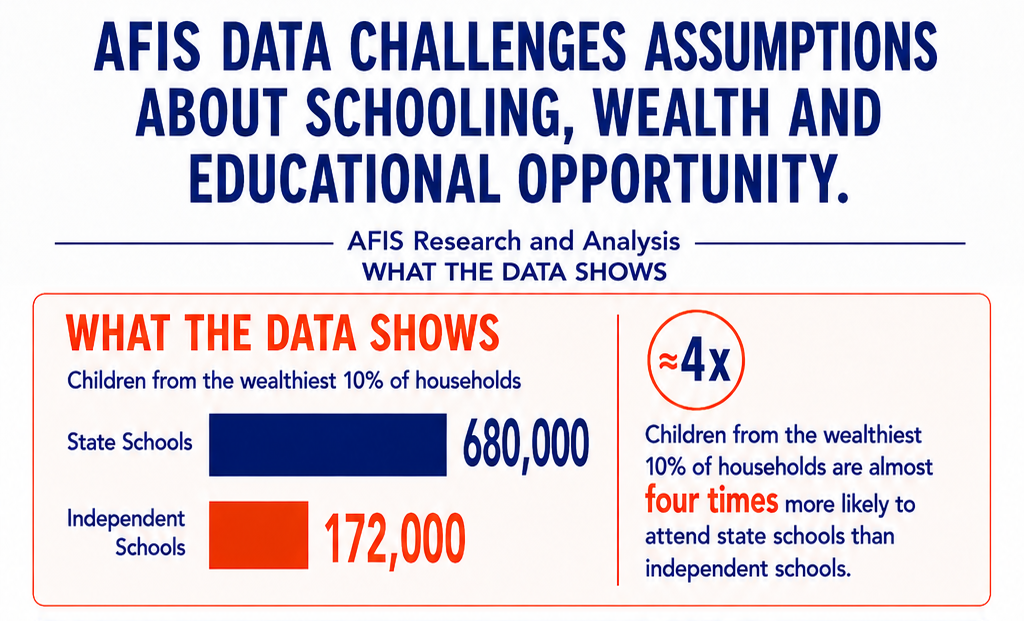
AFIS has spoken with several journalists and editors at national newspapers in recent months and provided analysis highlighting that there are approximately FOUR TIMES MORE children from the UK’s top income decile in state schools than in independent schools.
Indeed, there are more children from top-decile-income households in state schools than the entire pupil population of all independent schools combined.
That context, and the wider limitations of using school type as a simplistic proxy for wealth, privilege or advantage, was absent from these articles.
It is therefore reasonable to ask why the only national organisation representing independent-school families was not approached for comment in stories explicitly discussing inequality, representation and the socio-economic composition of those families.
We (Association For Families Of Independent Schooling (AFIS) C.I.C.), frustrated by the persistent use of images of Eton and Harrow used alongside articles about “private schools”, recently contacted a national newspaper picture researcher to ask why this was and how we could help to change the policy.
We asked what photos would typically be selected to represent coverage about state schools.
He did not suggest selecting the roughest schools with the worst OFSTED results, with scruffy-looking children exhibiting examples of poor behaviour as shorthand for the entire state sector. (Quite rightly)
Links to the articles discussed:
More private school scholarships go to the richest families:
https://www.thetimes.com/article/4215d8f1-55fd-4e3f-b1cb-bdc126c3a7a1?shareToken=4d3973252378865523bdbe08c039c65e
Wealthiest families ‘given third of private school grants’:
https://www.telegraph.co.uk/news/2026/05/25/wealthiest-families-given-third-private-school-grants/