26 August 2026
DOWNLOAD KEY DOCUMENTS:
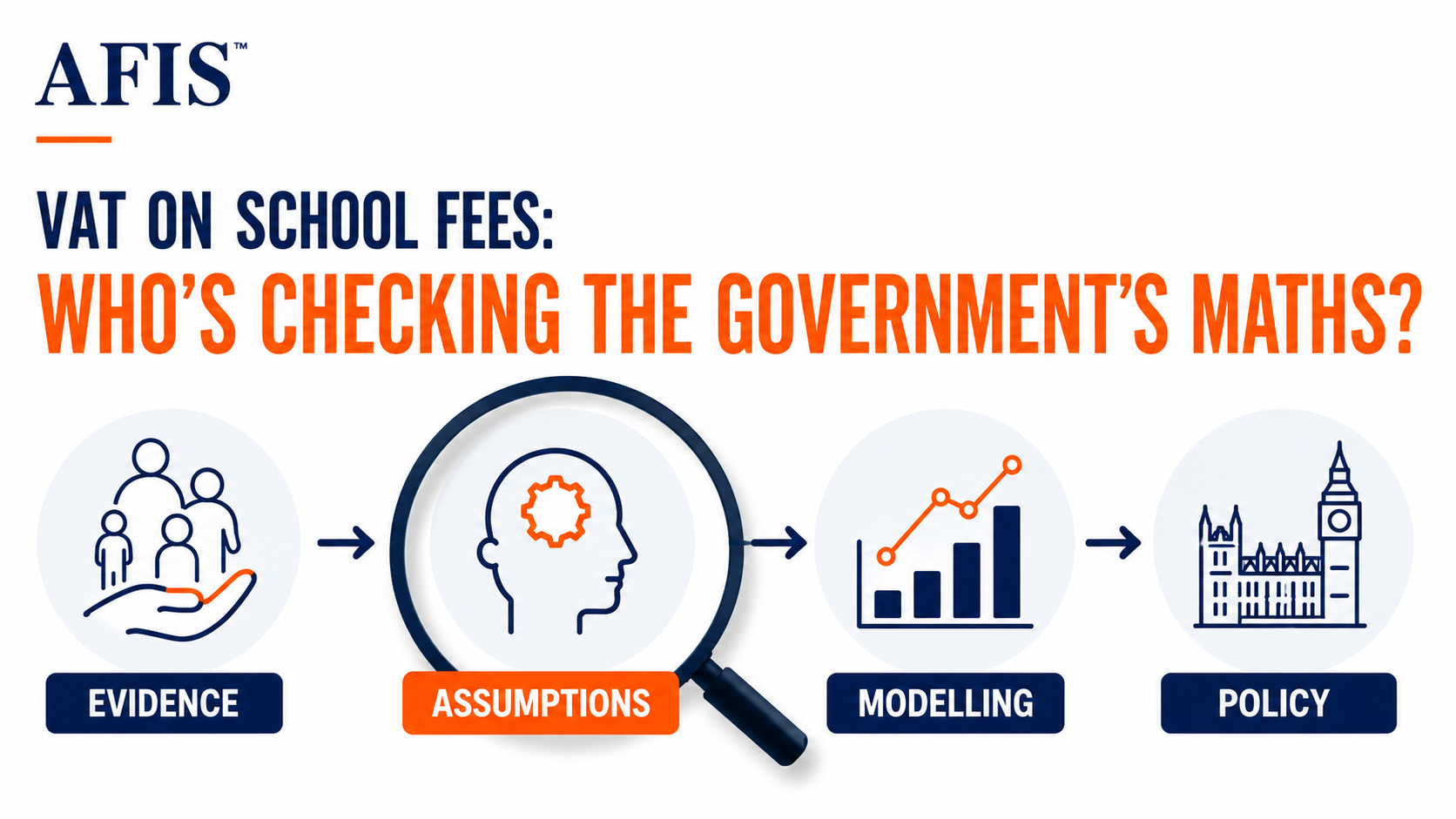
The Association for Families of Independent Schooling (AFIS) has published two linked reports and a supporting resource ledger examining the evidence, assumptions and modelling underpinning the Government's recent fiscal reforms affecting independent schooling.
Our purpose is not to argue that every Government assumption was necessarily wrong.
It is to ask whether reforms of this significance were supported by a sufficiently robust and transparent evidence base, and whether the assumptions and forecasts made before implementation now withstand scrutiny against the evidence available.
AFIS is calling for an independent review.
What we have published
1. The Case for an Independent Review
The Case for an Independent Review of the Evidence Base Underpinning Recent Fiscal Reforms Affecting Independent Schooling
Our overarching report examines the wider evidence base behind the reforms, including:
- assumptions about how families would respond;
- estimates of pupil movement between sectors;
- the cumulative effect of successive fiscal measures;
- school viability and capacity;
- post-16 pupil movement;
- demographic change;
- public-expenditure assumptions; and
- the adequacy of post-implementation monitoring and evaluation.
The report sets out the questions AFIS believes now warrant independent examination.
2. Review of the Accounting Boundaries
Review of the Accounting Boundaries Underpinning the Government's Published State Schooling Cost Estimates
The companion Technical Review examines one issue in much greater depth: how Government estimated the additional public expenditure associated with pupils moving from independent into state-funded education.
The Government's modelling used an average school-revenue funding figure of £7,690 per pupil aged 5–16.
AFIS asks whether that was the appropriate cost concept for estimating the expenditure consequences of additional pupils entering state-funded provision.
Our review identifies a minimum of approximately £2.93 billion of annual-scale public resource outside the £7,690 school-revenue funding boundary, comprising:
- approximately £2.01bn of pre-16 home-to-school transport;
- approximately £600m of Universal Infant Free School Meals; and
- £320m of Primary PE and Sport Premium.
AFIS does not claim that this £2.93bn represents an additional cost of the policy.
It should not be added to the Government's approximately £270m expenditure illustration and should not be used to construct an alternative “true cost per pupil”.
Instead, its significance is that it demonstrates the importance of defining the accounting and cost boundaries explicitly and asking:
Which public-expenditure mechanisms respond when additional pupils enter state-funded provision, for which pupils, under what circumstances, at what point and by how much?
The review also identifies further public resources which AFIS has deliberately not quantified where their funding origin, attribution or overlap with existing school funding cannot yet be established sufficiently robustly.
3. AFIS State Schooling Resource Ledger
The AFIS State Schooling Resource Ledger provides the supporting audit trail behind the accounting-boundary analysis.
It records the resources examined, their proposed classification, available source evidence, accounting and population boundaries, potential overlap and double-counting issues, and the reasons why particular resources have or have not been included in the quantified analysis.
A central principle of the work is:
Follow the funding, not the organisational form.
Public resources supporting education can flow through schools, central Government, local authorities, public bodies, local-authority companies, commissioned providers and other organisations.
The fact that a resource is delivered outside an individual school budget does not necessarily mean it sits outside the Government's £7,690 funding measure. Equally, relevant public expenditure may exist outside that boundary.
Where the available evidence does not allow those flows to be reconciled reliably, AFIS has not assigned an additional monetary value.
What AFIS is asking for
AFIS is asking for an independent, evidence-led review capable of testing the original assumptions and forecasts against the evidence now available.
Among other matters, we believe that review should examine:
- the behavioural assumptions used to estimate pupil movement;
- the distinction between average funding and marginal public expenditure;
- which public resources were inside and outside the Government's selected funding boundary;
- which expenditures actually respond when additional pupils enter state-funded education;
- the treatment of local-authority and other publicly funded resources;
- the cumulative effect of VAT, business-rates changes, pension and employment-cost pressures;
- school closures, capacity and post-16 movement;
- demographic change and its interaction with pupil-movement estimates; and
- the evidence emerging since implementation.
AFIS has submitted detailed Freedom of Information requests to HM Treasury, HMRC and the Department for Education seeking underlying modelling and analysis.
There are limits to what a small, parent-led organisation can reasonably be expected to reconstruct from published information. Some of these questions can only be answered properly by Government and the public bodies that hold the underlying data.
AFIS has identified the questions. We believe an independent review should answer them.
Media and research enquiries
Michelle Daniells
Founder & CEO
The Association for Families of Independent Schooling™ (AFIS™) C.I.C.